The Conversation Tax: Why Your WhatsApp Bill Is Killing Your Margin
The Invisible Profit Killer
Imagine this: Your marketing team launches a brilliant campaign. Your open rates are hitting 90%, and the orders are rolling in. But at the end of the month, your accounting department drops a bombshell. The bill from your WhatsApp Business Solution Provider (BSP) is larger than your actual profit margin from the campaign.
This isn’t a hypothetical scenario. In 2026, thousands of businesses are waking up to the reality of the "Conversation Tax." While WhatsApp started as a "cheap" alternative to SMS, it has evolved into a high-stakes toll road where every single interaction has a price tag.

The Story of "Bloom & Grow": A Cautionary Tale
Let’s look at a real-world example (names changed for privacy). Bloom & Grow, an international florist, migrated their customer engagement to WhatsApp Business API. On Valentine’s Day, they sent out a "15% Off" broadcast to 20,000 customers in the UAE and Brazil.
- The Result:
1,200 orders. A massive success, right? - The Catch:
Meta categorized these as "Marketing Conversations." In the UAE, the cost was roughly $0.04 per delivered message. In Brazil, it was even higher. - The Math:
$0.04 x 20,000 = $800 just for the privilege of sending the messages.
After factoring in the cost of goods, shipping, and the monthly platform fee for their CRM, Bloom & Grow realized they actually lost money on every flower bouquet sold through that campaign. They weren't building a business; they were funding Meta’s data centers.
Understanding the 2026 Meta Pricing Matrix
To understand how to make WhatsApp messages cheaper, you first have to understand the complex (and often confusing) way Meta charges you. Gone are the days of simple flat rates. Today, you are billed based on the Category of Conversation:
- Marketing Conversations: These are the most expensive. If you mention a discount, a new product, or a re-engagement offer, you’re paying the top tier.
- Utility Conversations: Notifications about orders, shipping updates, or receipts. They are slightly cheaper but still carry a per-message cost.
- Authentication Conversations: OTPs and login codes.
- Service Conversations: When a customer messages you first. You get a "free" 24-hour window, but the moment you try to follow up after that window, the meter starts running again.
Meta offers a "1,000 free service conversations per month" tier, but for any scaling business, this is gone in the first two days. Beyond that, you are at the mercy of regional pricing, which can fluctuate.
| Region | Marketing Cost (Est. 2026) | Annual Cost (10k msgs/mo) |
|---|---|---|
| European Union | €0.06 - €0.12 | €7,200 - €14,400 |
| UAE / Middle East | $0.035 - $0.05 | $4,200 - $6,000 |
| Brazil / LatAm | $0.05 - $0.07 | $6,000 - $8,400 |
Is There a Way to Reduce WABA Costs?
Most "experts" will tell you to optimize your templates or use shorter windows. But those are just band-aids on a bullet wound. Even with the best optimization, you are still paying for access to your own customers.
The real question savvy founders are asking in 2026 isn't "How can I make WhatsApp cheaper?" but rather "Why am I paying for a message when I could own the platform?"
Enter the Zero-Tax Era: The Telegram Mini App Revolution
While Meta was busy building toll booths and complex billing matrices, Telegram was quietly constructing an entirely different infrastructure. A Telegram Mini App (TMA) isn't just another bot—it is a full-scale web application (built with Angular, React, or Vue) that lives inside the messenger.
For the business owner, this represents a fundamental shift in the economics of digital commerce.
The most striking difference is the price of communication. In a TMA, your business gains unlimited push notifications and marketing broadcasts for $0. Whether you have 1,000 or 1,000,000 users, sending a "New Arrival" alert or a personalized discount doesn't cost a single cent in platform fees.
In the same scenario where Bloom & Grow paid $800 to Meta, a Telegram-based business would have paid exactly nothing. This isn't just a saving; it's a massive competitive advantage that allows for more frequent, high-converting engagement without budget anxiety.
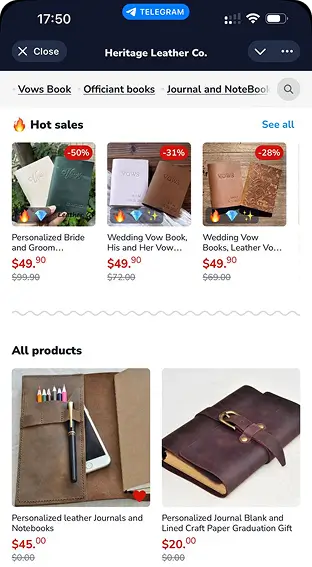
Traditional mobile apps are burdened by the "30% Apple/Google Tax" on digital goods and rigorous, often slow, approval cycles. WhatsApp, on the other hand, limits you to rigid text bubbles and basic buttons.
Telegram Mini Apps break both barriers:
- Total UI Freedom: You can build a professional storefront with high-resolution catalogs, interactive filters, and smooth animations that feel like a native iOS or Android app.
- Zero Friction: There is no "Download" button. Users tap a link, and the app opens instantly, already knowing who they are through Telegram’s secure authentication.
- Direct Payments: Unlike the walled gardens of other platforms, Telegram allows you to integrate your preferred payment gateway (like Stripe or local providers) directly. For physical goods, you keep 100% of your revenue—Telegram takes no commission.
In the WhatsApp world, you are constantly racing against the 24-hour clock. If you don't close the sale or solve the problem in time, you pay a "re-opening fee."
In Telegram, the conversation is persistent. You own the relationship. You can follow up with a customer three days later to ask how they liked their purchase, or send a loyalty reward a month later, without ever seeing a bill for "initiating a conversation."
The Million Dollar Question: Why Does Anyone Still Use WhatsApp?
If Telegram Mini Apps are clearly more cost-effective and flexible, why is the majority of the business world still tethered to Meta’s expensive ecosystem?
The answer isn't just about "user base size"—it’s about a psychological trap that Meta has spent billions to build. Most businesses are currently falling for a specific billing illusion that makes them feel they are saving money while their margins are actually being bled dry.
But the "Conversation Tax" is only the tip of the iceberg. There is something even more dangerous lurking in your WhatsApp Business account—a structural flaw that can freeze your customer support and kill your sales overnight without a single warning.
We’ll expose the 24-Hour Death Trap. We will show you the exact math of how a simple delay in customer service can inflate your monthly expenses by 300% and why your support team is unknowingly working for Meta’s profit, not yours.

